
Description
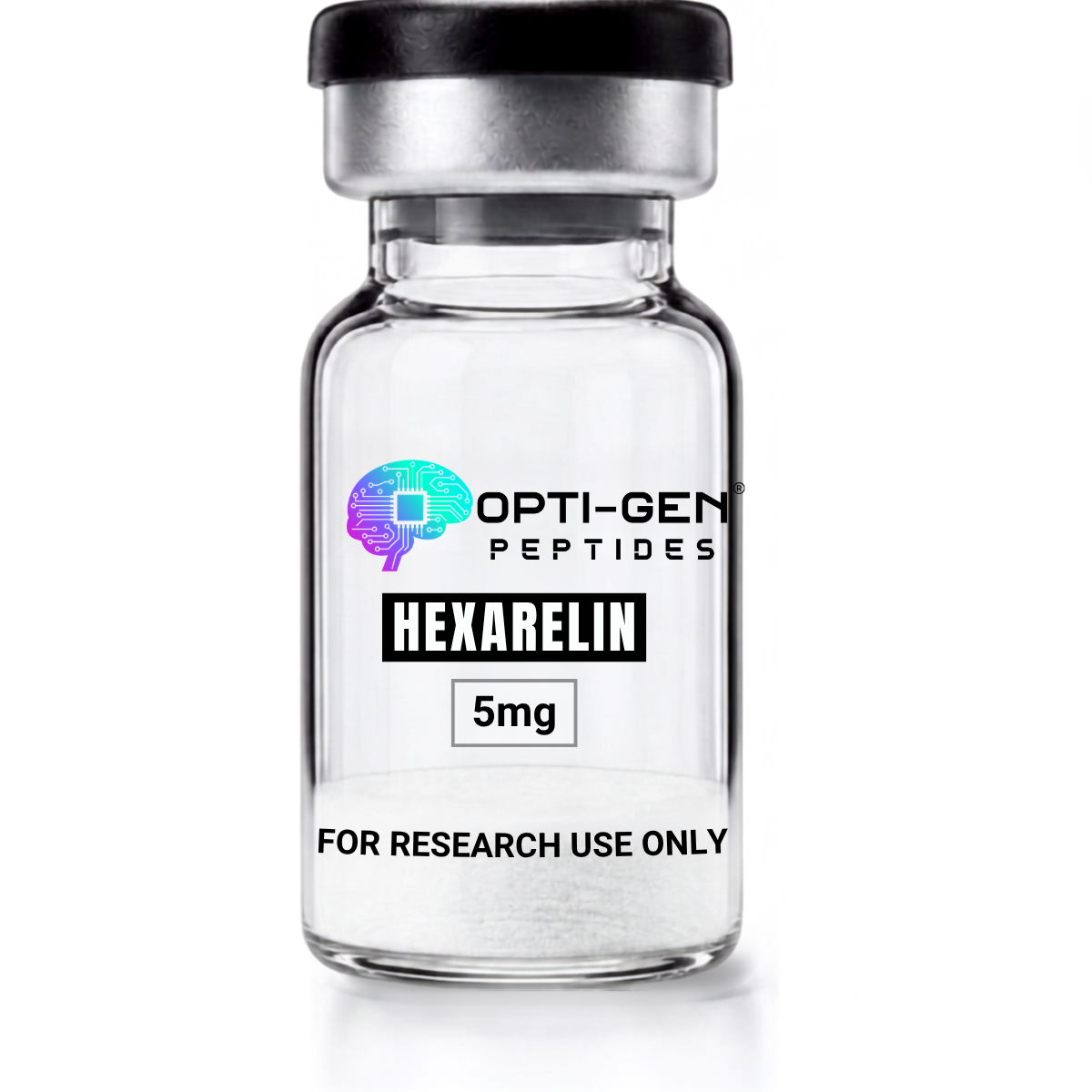
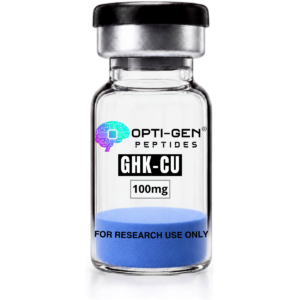
Hexarelin | 5mg Vial
Hexarelin 5 mg — Opti-Gen Peptides
For laboratory research use only.
Not for human use. Not for veterinary use.
Not licensed by the MHRA. Not a medicinal product.
This item is a research chemical supplied as a 5 mg sealed vial for lawful laboratory and scientific research in the United Kingdom. It is not a medicine, food, supplement, cosmetic or medical device. It is not authorised to diagnose, treat, cure or prevent any disease or condition.
Purchase is intended for qualified research settings. This product must not be administered to people or animals.
Product identification
| Product name | Hexarelin |
| Supplier | Opti-Gen Peptides |
| Contents | 5 mg per vial |
| Form | Research vial as labelled |
| CAS | 140703-51-1 |
| Molecular formula | C₄₇H₅₈N₁₂O₆ |
| Sequence | His-D-2-methyl-Trp-Ala-Trp-D-Phe-Lys-NH₂ |
| Type | Synthetic hexapeptide |
| Intended use | In-vitro / laboratory research only |
Quality documentation
Lot records (where issued) may include identity and purity data from the stated analytical method. Only figures shown on the certificate for that lot apply. No statement on this page is a guarantee of pharmaceutical grade, sterility for injection, or suitability for any use outside the laboratory.
Storage
Store as a laboratory chemical under your institution’s standard procedures, dry and protected from light. This page does not provide preparation or application instructions.
Published literature (researchers only)
Hexarelin is indexed in chemical and biomedical databases as a synthetic peptide used in laboratory and investigational research. Scientific papers discuss its chemical structure and experimental use as a research ligand. Those publications are independent of this sale. They are not product claims and do not authorise human or veterinary use.
UK notice
- Not approved or licensed by the MHRA
- Not placed on the market as a medicine under the Human Medicines Regulations 2012
- Not for human consumption or administration
- Not for animal consumption or veterinary use
- Not for diagnostic or therapeutic procedures
- Adults 18+ only
- The purchaser is responsible for compliance with UK law and institutional rules
By ordering you confirm that you are acquiring this material solely for lawful laboratory research and that you will not use or resell it for unauthorised human or animal use.
Published research context
Hexarelin (examorelin; developmental codes EP-23905 / MF-6003) is a synthetic hexapeptide derived from the GHRP-6 series and characterised in the 1990s. It has no sequence homology with ghrelin but is used in research as a GHS-R1a (ghrelin receptor) agonist. It is not an MHRA-licensed medicine and has not been authorised for clinical use.
Researchers typically consult the literature under these headings. Citations are for scientific context only and do not imply that this 5 mg vial is suitable for any human or veterinary application.
1. Receptor and peptide chemistry
Hexarelin is His-D-2-methyl-Trp-Ala-Trp-D-Phe-Lys-NH₂ (CAS 140703-51-1; ~C₄₇H₅₈N₁₂O₆). The 2-methyl-D-tryptophan residue is the main structural difference from GHRP-6 and is discussed in structure–activity papers as increasing metabolic stability and GHS-R1a binding relative to the parent hexapeptide. Laboratory work often uses it as a reference GHRP when comparing secretagogue ligands.
2. Pituitary / GH-axis investigations (historical human and preclinical papers)
Early clinical pharmacology papers (1990s) reported that hexarelin stimulated pulsatile growth-hormone release in experimental settings and was among the more potent GHRPs tested on a per-mass basis in those study designs (e.g. work associated with Ghigo, Arvat, Deghenghi and colleagues). The same literature notes non-selective endocrine readouts in some protocols (including cortisol and prolactin changes) and attenuation of GH response with repeated administration in short research series. Those findings belong to investigational study reports; they are not product performance claims.
3. GHRH co-administration models
Published designs sometimes combined a GHRP (including hexarelin) with GHRH or GHRH analogues to study synergistic GH pulses in controlled research settings. This is a methodological point for assay or endocrine-model design, not a stacking recommendation.
4. Non-GHS-R1a binding (preclinical)
A separate line of work describes hexarelin binding at CD36 on cardiac tissue and cardioprotective signals in animal ischaemia / reperfusion and related models, including observations discussed as partly independent of GH release (e.g. Muccioli and follow-on preclinical papers). This evidence is largely animal and mechanistic. It must not be rewritten as a heart, fitness, or recovery claim.
5. Other experimental systems
Additional papers explore hexarelin in in-vitro and animal models (receptor signalling, apoptosis assays, tissue-injury models, including some neuroprotection work in rodents). These are hypothesis-generating laboratory studies, not authorised indications.
6. What the literature does not support for marketing
- No completed Phase III programme and no marketing authorisation in the UK or elsewhere as a medicine.
- No lawful basis to present this vial as a treatment, supplement, or performance product.
- Growth hormone secretagogues are prohibited in sport by WADA (S2). That is an anti-doping classification, not an efficacy claim.

Reviews
There are no reviews yet.